

How do you avoid vendor lock-in with supply chain planning software?
 Gary Sahota
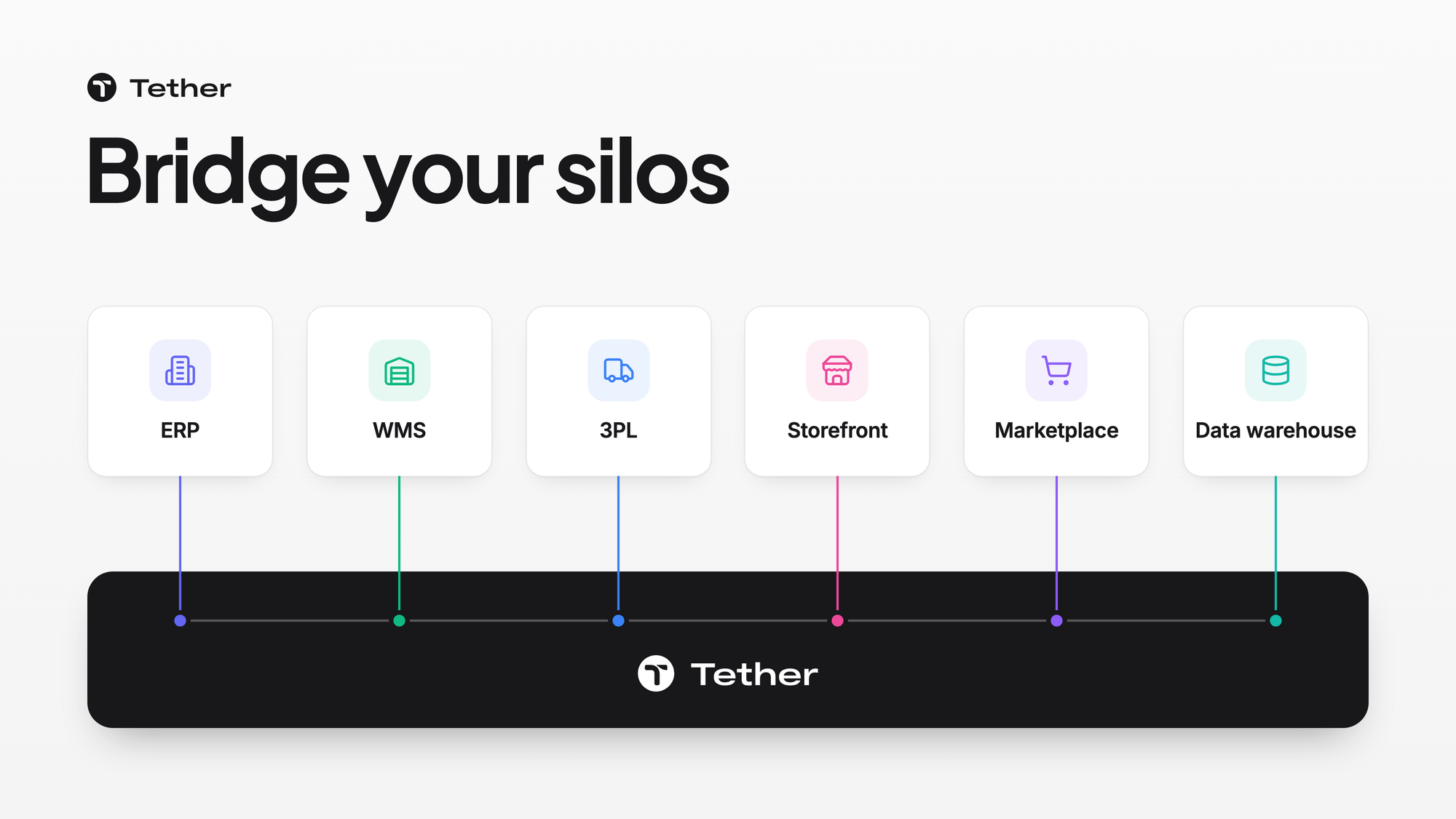
Tether keeps lock-in low by working with the systems you already run. It can run on top of your existing ERP and WMS without replacing them. Tether AI maps your data as-is. If you leave, Tether exports your data within 30 days and confirms in writing that it has been deleted. Check any planning tool against the same terms before you sign.
Where lock-in comes from in planning software
Lock-in builds up when leaving a planning tool would cost more than staying with it. Most of that cost is set at signing by the contract terms and by how the tool connects to the rest of your stack.
These are the places to look:
- Whether you can get all of your data back and in what format.
- The contract length and the notice you have to give.
- The systems the tool asks you to replace before it works.
- Whether your sales, orders, and plans have to be rebuilt in a data model only that vendor uses.
- Whether your team can reach the tool only through its own screens.
- Whether every brand and channel you run fits in one setup.
- Fees that grow as you add people or data.
The sections below show how Tether handles the items its terms cover.
Read the exit, pricing, and support terms before you sign
The exit terms are the clearest test of lock-in. Ask every vendor three things: how fast you get your data back, what format it comes in, and what happens to the copy the vendor keeps.
Tether covers the first and the last. Tether sends the export within 30 days and puts the deletion in writing. Ask about the export format too, so you know the data will load into your next system.
Fees that rise with each new user or more data make a tool cost more as you grow. Tether has no usage fees, no per-user fees, no data fees, and no onboarding fees. Get the contract length and notice period in writing.
Then check the reliability terms. Tether guarantees 99.5% uptime, and urgent requests get a response within 24 hours.
Keep the ERP, WMS, and 3PLs you already run
A tool that makes you replace your core systems before it works ties more of your operation to that one vendor.
Tether runs in three ways:
- As a planning layer on top of the ERP you already have.
- As a replacement for an ERP you have outgrown.
- As the foundational system for a brand with no ERP yet.
On the warehouse side, Tether connects to the warehouses and 3PLs you already use and decides where each order should go under routing rules you build. Your 3PL or WMS still runs the floor. Tether unifies your own warehouses and 3PLs into one stock view. You can map each channel to its default warehouse, so Amazon fulfills from one location while DTC can fulfill from another.
Purchase order management in Tether syncs with your ERP. Tether can push orders to other systems while it keeps the full record. Your team can send planned orders it has accepted to NetSuite.
Bring your data in as it is
Ask whether a tool can read your data where it lives today or needs it rebuilt in its own model first.
Tether pulls sales from Shopify, Amazon, EDI, your ERP, or data warehouses like BigQuery and Snowflake for demand planning. Numbers update near real-time with lightweight delta syncs. Tether also pulls in your existing demand plans alongside sales history, inventory position, and purchase orders.
Orders pull straight from your existing systems, so there is nothing to re-enter. The integrations page lists 245+ integrations. Connecting Amazon takes less than a minute.
Tether AI ingests any format without templates, including PDF, CSV, Excel, and screenshots. It maps many external IDs to one internal SKU. Include that mapping when you ask about the export format.
No data cleaning is required. Tether's team handles the data migration and mapping for you.
Why an agentic operations platform lowers lock-in
An agentic platform can lower lock-in when it does its work on top of the systems and data you already have, instead of inside a structure you rebuild first.
When a planning suite needs your SKUs, channels, and rules rebuilt in its own structure, each new warehouse or channel becomes one more setup to unwind if you leave.
Tether AI connects channels, data warehouses, and ERPs, and it meets your brand where it is. When you add a new warehouse, a new SKU, or a new cost, Tether AI replans.
Tether AI is not tied to one screen. It works wherever you work, in Claude, ChatGPT, voice, or any MCP client. It also exposes a REST API for custom integrations.
In the Tether app, the work Tether AI does stays visible to your team. There it drafts POs, runs scenarios, watches inventory, and shows every action it takes. Each change it drafts in the app is recorded in a visible edit log that shows who, what, why, before, and after.
Apply the same exit test to any AI built into a planning tool. Ask where its record of changes lives and whether that record comes back with your data when you leave.
FAQ
What if we outgrow our ERP later?
Tether can run as a replacement for an ERP you have outgrown, as well as a planning layer on top of the ERP you have today. You can read how Tether sits next to the rest of your stack in Tether integrates with all the systems in your supply chain.
Can Tether plan across many sales channels at once?
Tether forecasts demand for each SKU in each sales channel, and planners can group and filter the forecast grid by channel or SKU. Sales orders flow in from Shopify, Amazon, TikTok, and wholesale EDI, and Tether routes each one to the right warehouse. Tether AI also models complex channel hierarchies that run from distributor to retailer to door.
Which warehouses and 3PLs can Tether connect to?
The integrations page lists WMS and 3PL integrations including ShipBob, ShipHero, ShipMonk, Extensiv (3PL Central), Stord, and Flowspace. A 3PL or WMS connection brings sales orders, inventory levels, and purchase orders into Tether. Integrating 3PLs and warehouse management systems with Tether has more on those connections.
Does Tether place orders on its own?
When Tether predicts a stockout, it recommends a purchase or transfer. Nothing is ordered until someone on your team accepts it and places the order.
How long does implementation take?
Tether's implementation FAQ says implementation typically takes 2 to 4 weeks. Ask any vendor for the same number, since a long setup is part of what makes a tool hard to leave later.
What support do we get during onboarding?
Every plan includes optional weekly 30-minute calls during onboarding. For day-to-day help, every plan also includes a dedicated Slack channel or email for support.


