

How does Tether Data compare to Fishbowl for demand and supply planning?
 Gary Sahota
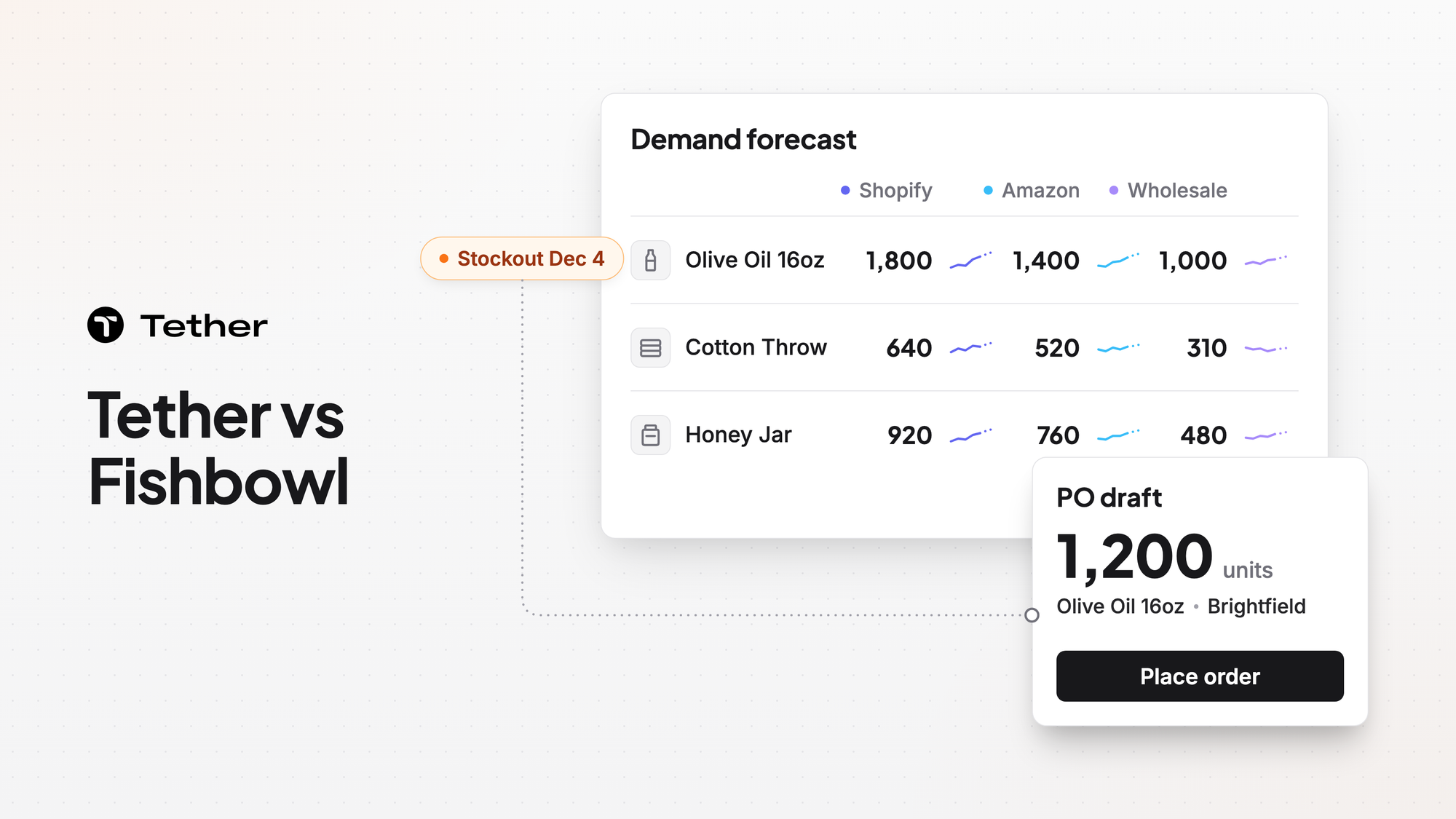
Tether forecasts demand for each SKU in each sales channel and drafts purchase orders that respect your supplier minimums, lead times, and preferences. Fishbowl is inventory and manufacturing software, and its plans offer demand forecasting as an add-on or as an included feature. Tether can replace Fishbowl for inventory, purchase orders, lots, and production, or run as a planning layer on top of it.
What is Fishbowl built to do?
Fishbowl runs inventory and manufacturing for businesses that keep their books in QuickBooks or one other accounting system. It covers real-time counts at every location, reorder points, purchasing, and pick, pack, and ship by scan. Fishbowl Advanced Manufacturing adds MRP, routing, and lot genealogy for multilevel or regulated production.
Planning is part of the Fishbowl lineup too, and how you get it depends on your plan. Fishbowl's pricing page lists demand forecasting as an add-on on the Growth plan and includes demand forecasting and planning on the Scale plan.
How does Tether handle demand and supply planning?
Tether builds a forecast per SKU and channel, and on the supply side it recommends reorders and drafts purchase orders.
On the demand side, Tether pulls sales from Shopify, Amazon, EDI, ERP, or data warehouses like BigQuery and Snowflake, and the numbers update near real-time with lightweight delta syncs. Planners group and filter the forecast grid by channel or SKU. Demand planning runs pre-built algorithms such as rolling averages, seasonal trends, and momentum in the background, and you can run different forecasting methods for different product lines.
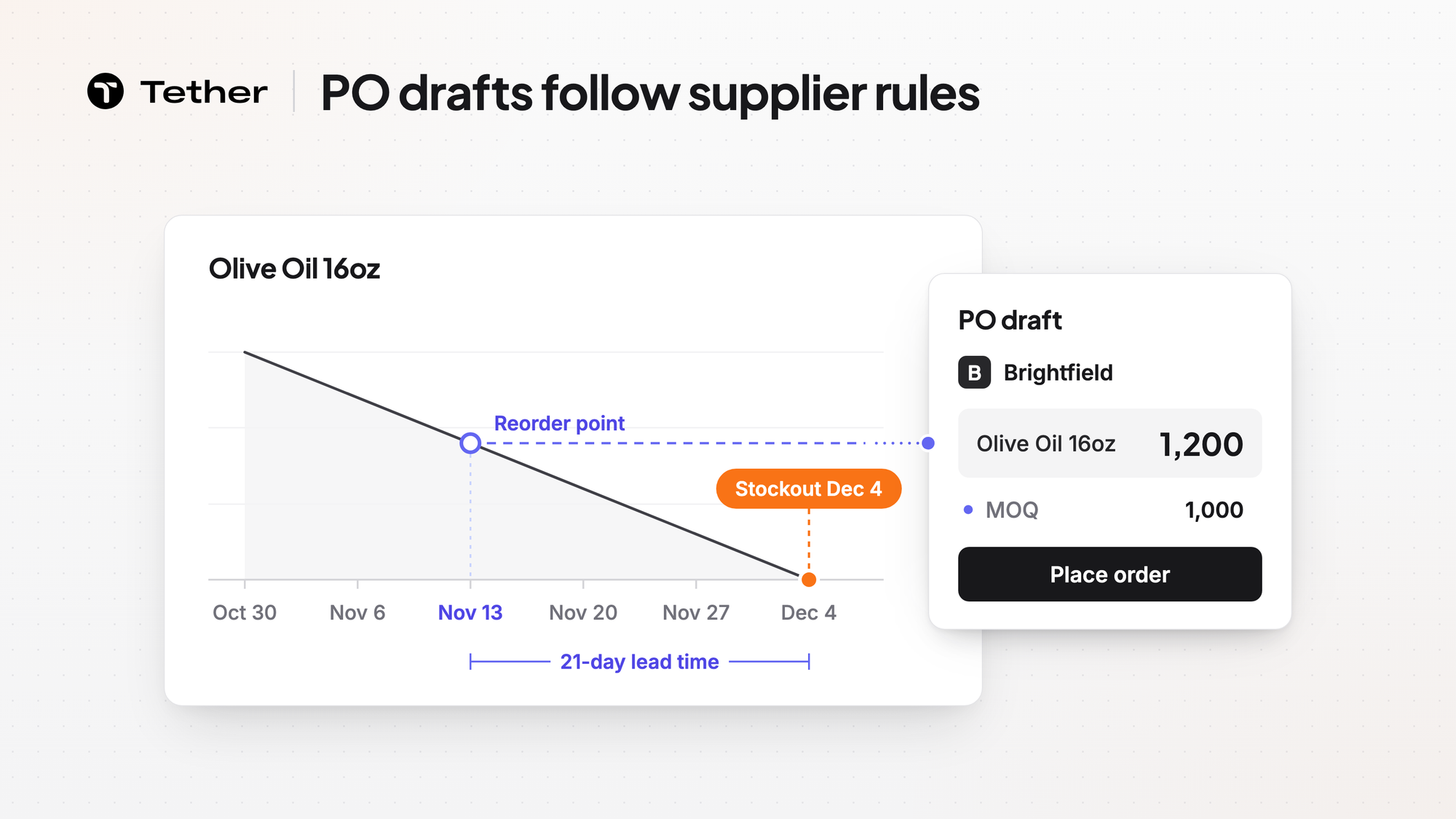
On the supply side, Tether predicts the stockout date per SKU per warehouse and recommends replenishment. Purchase order drafts appear when your coverage hits your reorder point, and each draft already respects your supplier minimums, lead times, and preferences. Supply planning keeps multiple suppliers per product, splits orders across suppliers by your own rules, and bases every reorder on what suppliers have actually delivered. Nothing is ordered until someone on your team accepts the recommendation and places the order.
If the two terms blur together, this post explains demand planning versus supply planning.
How do Tether and Fishbowl compare side by side?
Fishbowl and Tether both track inventory across locations. Here is each area side by side.
- Deployment. Fishbowl Inventory is cloud software. Fishbowl Advanced is listed with cloud hosting included and flexible deployment. Fishbowl's Windows setup steps for Fishbowl Advanced have you download the Fishbowl Server onto a computer running MySQL 8 and the Fishbowl Client onto other computers connected to it. Tether runs as a planning layer on top of the ERP you already have or as a replacement for an ERP you have outgrown.
- Demand planning. Fishbowl forecasts from historical sales data and trends. Demand forecasting is an add-on on its Growth plan and included on its Scale plan. Tether forecasts by SKU and by sales channel.
- Supply planning. Fishbowl covers reorder points and purchasing and its forecasting helps draft purchase orders. Its Advanced Manufacturing product adds MRP. Tether drafts each PO to your fastest, cheapest, or most reliable supplier. It respects MOQs, lead times, batch sizes, and pallet counts.
- Multi-warehouse. Fishbowl Inventory tracks stock at every location and moves it between sites. Tether gives reorder and transfer recommendations per SKU and per warehouse.
- Multi-channel. Fishbowl lets you sell on Shopify, Amazon, and your own store from one count. Tether takes sales orders from Shopify, Amazon, TikTok, and wholesale EDI and lets you map each channel to its default warehouse.
- 3PL. Fishbowl Advanced is for businesses that make products or run multi-warehouse, 3PL, or EDI-driven fulfillment. Tether unifies your own warehouses and 3PLs into one stock view.
- Reporting. Fishbowl lists advanced reporting on its Scale plan and custom reports as an add-on. Tether AI builds a custom report with tables and charts on request and reruns it on a schedule.
- Integrations. Fishbowl keeps QuickBooks or one other accounting system in place for your books. Tether lists 260+ integrations.
What does switching from Fishbowl to Tether look like?
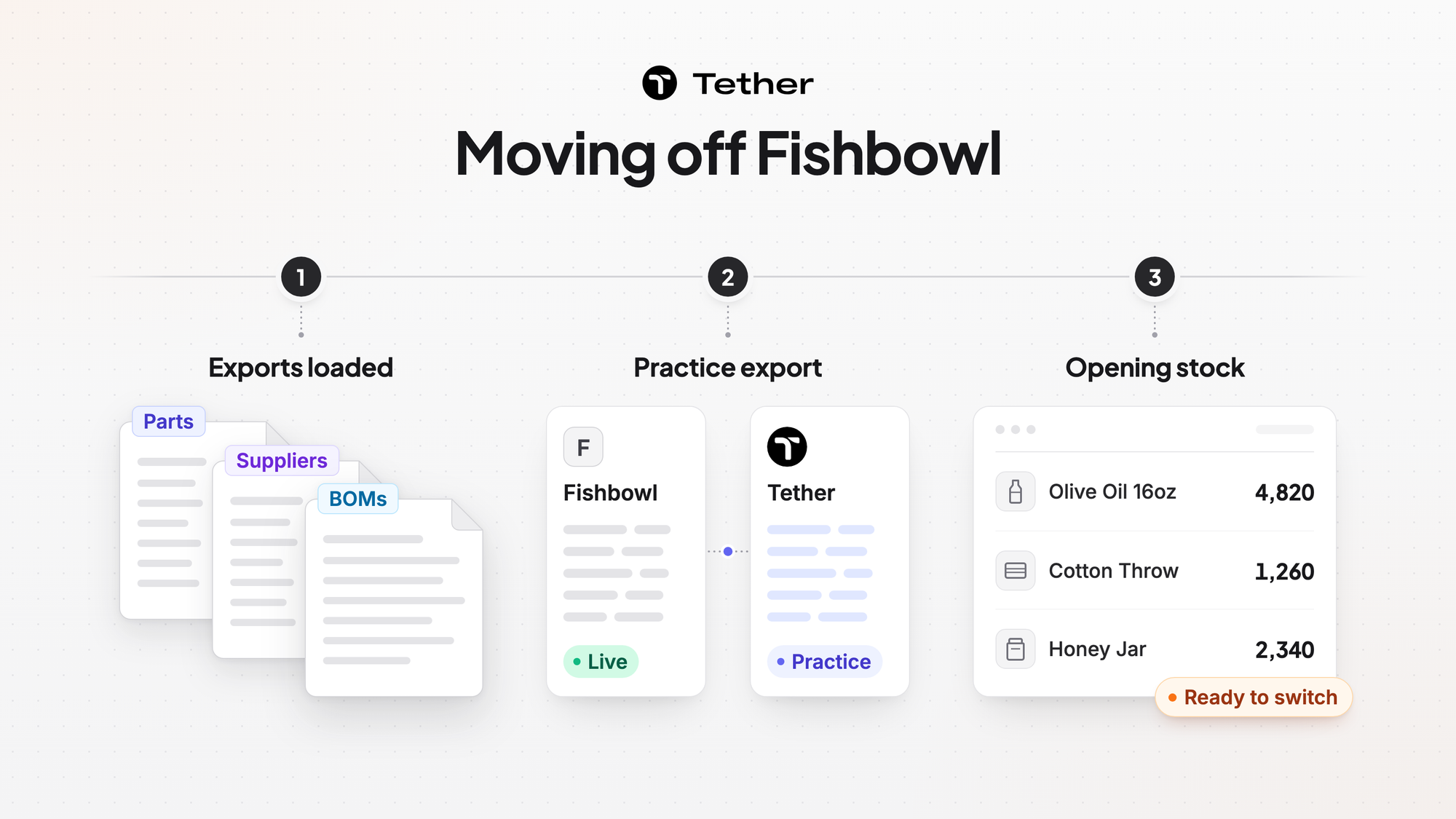
Tether's team runs the data migration and mapping for you. Here is how it went for a brand we work with that moved off Fishbowl and now runs inventory, purchase orders, lots, and production in Tether. Their move ran in three steps:
- Their team sent exports and Tether's team loaded the parts, suppliers, and BOMs.
- A practice export let their team try real work in Tether while the old system stayed live.
- Tether's team loaded opening stock from a final export before the switch.
Every plan includes a dedicated Slack channel or email for support, and optional weekly 30-minute calls during onboarding.
Ready to plan your move? Book a demo to walk through it with Tether's team.
Not ready to leave Fishbowl?
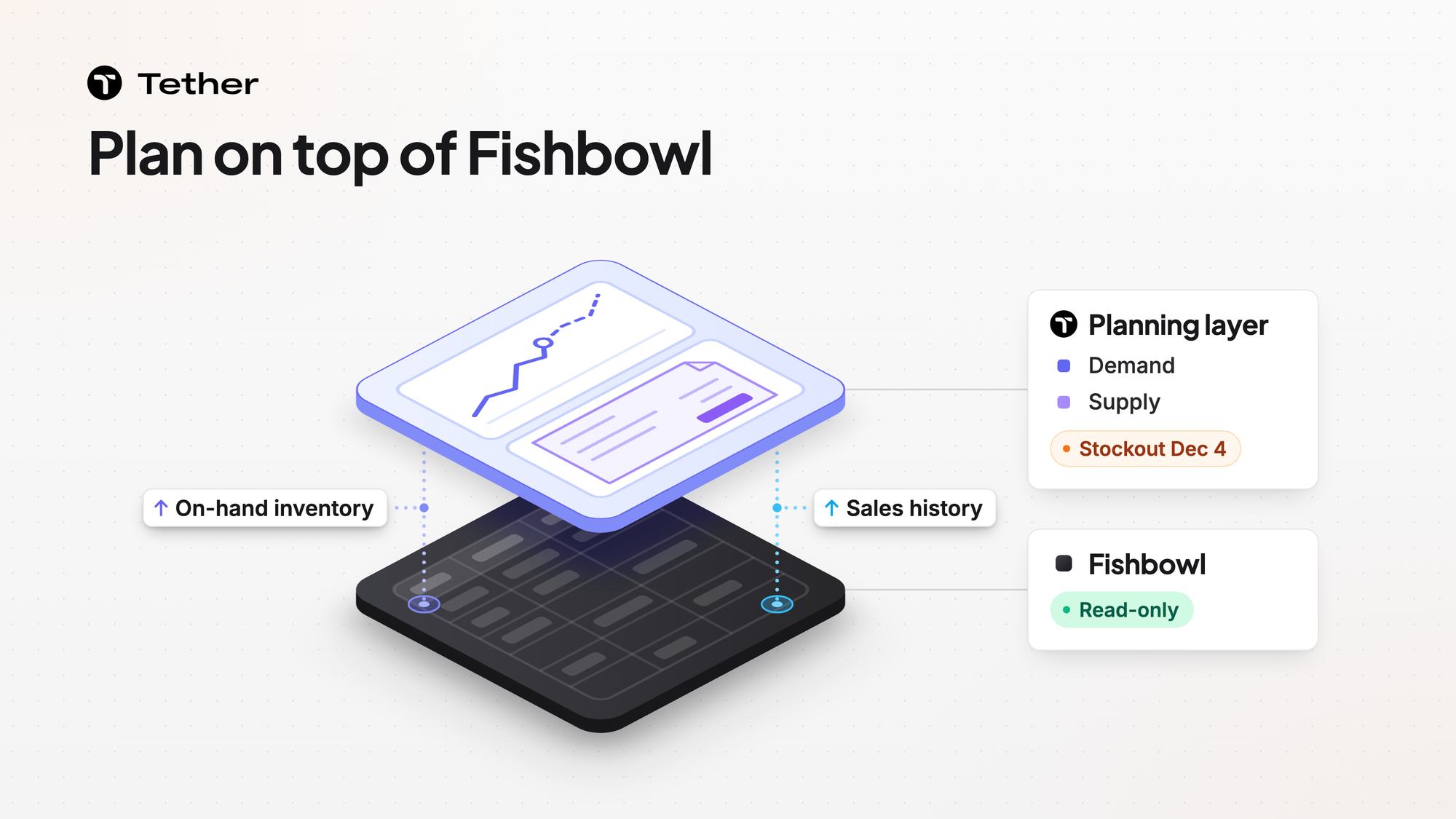
Tether connects to it and adds demand and supply planning on top. The connector reads two things from it: on-hand inventory by location group and shipped sales history by SKU. It is read-only: Tether does not write to Fishbowl. Tether's team sets up the connection for you.
Want to add planning to your Fishbowl stack? See the integrations Tether supports or book a demo.
FAQ
Is Tether a Fishbowl alternative or an add-on to Fishbowl?
It can be either. Tether is a modular system that can be a full-fledged ERP or sit on top of existing ERPs and WMSs without replacing them. A brand with no ERP yet can also start on Tether as its foundational system.
Does Fishbowl include demand forecasting?
Fishbowl offers demand forecasting, and its pricing page shows which plans include it. Fishbowl's forecasting helps you set reorder points and draft purchase orders.
Who sets up the connection between Tether and Fishbowl?
Tether's team does the setup. They connect your systems, map your data as it is today, and validate the numbers with you before you go live.
Do we have to clean up our data before moving off Fishbowl?
You can bring your data as it is today. Tether's team handles the data migration and mapping for you, and no data cleaning is required.
Does Tether replace our 3PL or warehouse system?
Tether connects to the warehouses and 3PLs you already use and decides where each order should go, under routing rules you build. Your 3PL or WMS still runs the floor.
Does Tether charge per user?
Tether has no per-user fees. It also has no usage fees, no data fees, and no onboarding fees.


