

How Tether AI ✨ remembers your business
 Gary Sahota
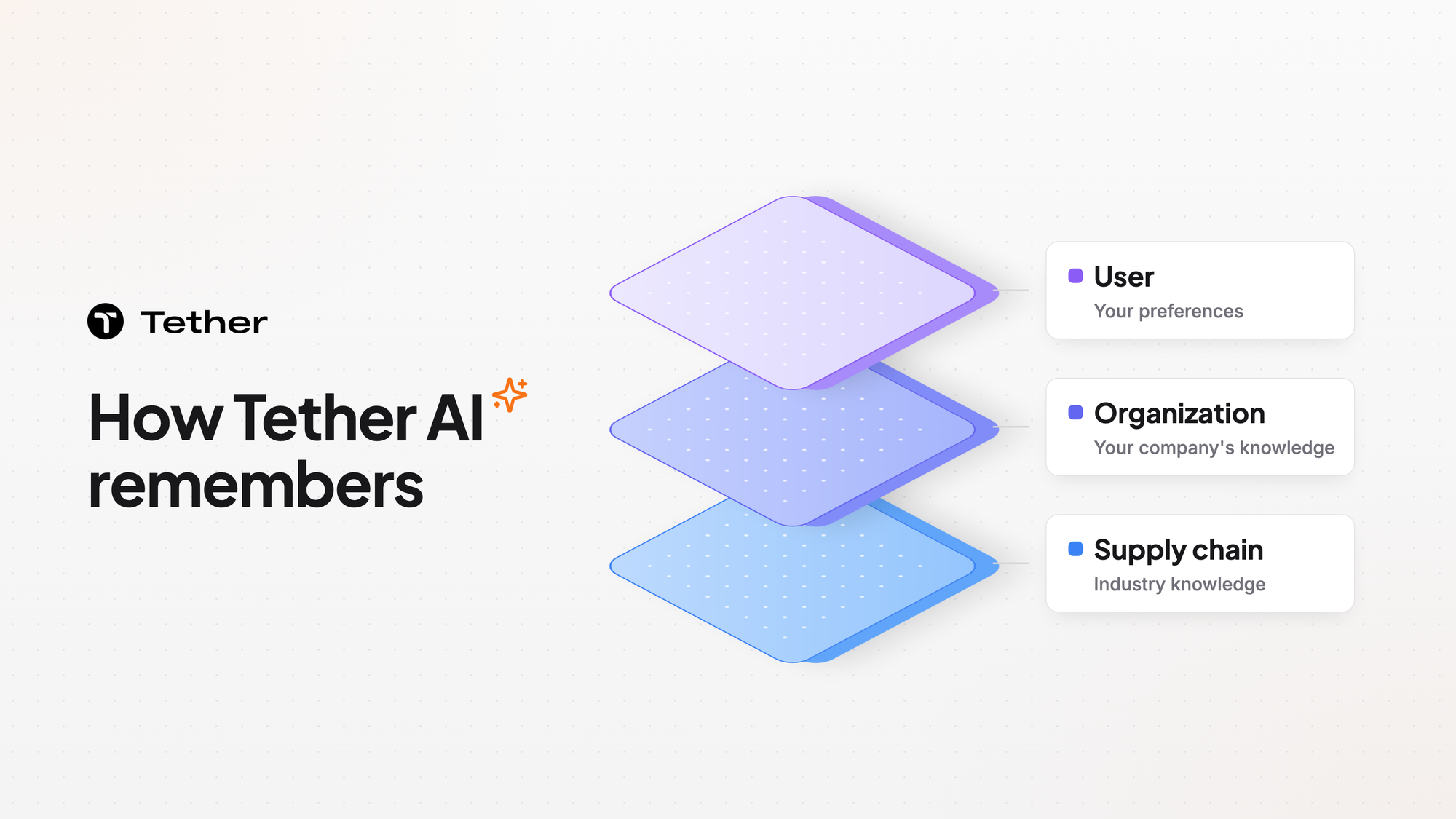
Tether AI, the in-house supply chain teammate inside Tether, keeps memory for your organization and for each user on your team. A supply chain layer knows what a SKU, a PO, a supplier, and a transfer are. You ask for what you need in plain English. In the Tether app, the changes it drafts wait for your approval.
Working with Tether AI day to day
Day to day, you work with Tether AI in chat.
It answers ad-hoc inventory, sales, and cost questions and walks you step by step through any task. You can update forecasts and inventory by chat, and draft POs and fulfill sales orders the same way. Before any destructive action, it asks for clarification.
Inside the Tether app, the POs and other changes Tether AI drafts wait for your approval before they are applied. A visible edit log records each change with who, what, why, before, and after.
Why a planning teammate needs layered memory
A planning teammate needs memory at more than one level because a planner's knowledge comes in more than one kind.
Think about what a new planner learns in the first months on your team.
- The trade. A planner knows what a purchase order is and how a transfer between warehouses works before joining you.
- The company. A planner learns your suppliers, your warehouses, and your sales channels.
- The people. A planner learns that one colleague reviews orders by supplier and another starts the week with the stockout list.
Each kind changes at its own pace. The basics of the trade rarely change. Company knowledge changes when the business adds a supplier, a warehouse, or a channel. Habits differ from one person to the next.
For a brand that sells through retail, wholesale, and DTC, the company kind of knowledge runs deep. It covers which warehouse serves which channel, which co-packer makes which product, and which supplier tends to run late.
A teammate with no memory is like a temp who starts fresh every morning. You explain the suppliers, the warehouses, and the way you like to see the numbers all over again. Each time, the real question waits until that context is rebuilt, and any detail you forget to repeat is missing from the answer.
The three layers in Tether AI
Tether AI keeps memory at three levels.
- Organization layer. Tether AI keeps memory for your organization as a whole.
- User layer. It keeps memory for each person on your team who uses it.
- Supply chain layer. It knows what SKUs, POs, suppliers, and transfers are.
The four objects in everyday work
SKUs, POs, suppliers, and transfers run through the work Tether AI does in Tether.
Tether AI predicts the exact stockout date per SKU, per warehouse. It drafts purchase orders the moment coverage hits reorder. Those orders respect MOQs, lead times, batch sizes, and pallet counts. It tracks every PO from draft to shipment to receipt. It recommends inter-warehouse transfers to cover a shortfall. It replans on every change, such as a new warehouse, a new SKU, or a new cost.
Because the supply chain layer knows what these objects are, your question can start with the decision you face, such as whether you need a transfer, instead of with a definition.
See the full range of work Tether AI covers on the AI supply chain teammate page. Tether AI is part of Tether, the operations system for consumer brands.


