

How does Tether Data handle supplier lead times and purchase order management across multiple suppliers?
 Gary Sahota
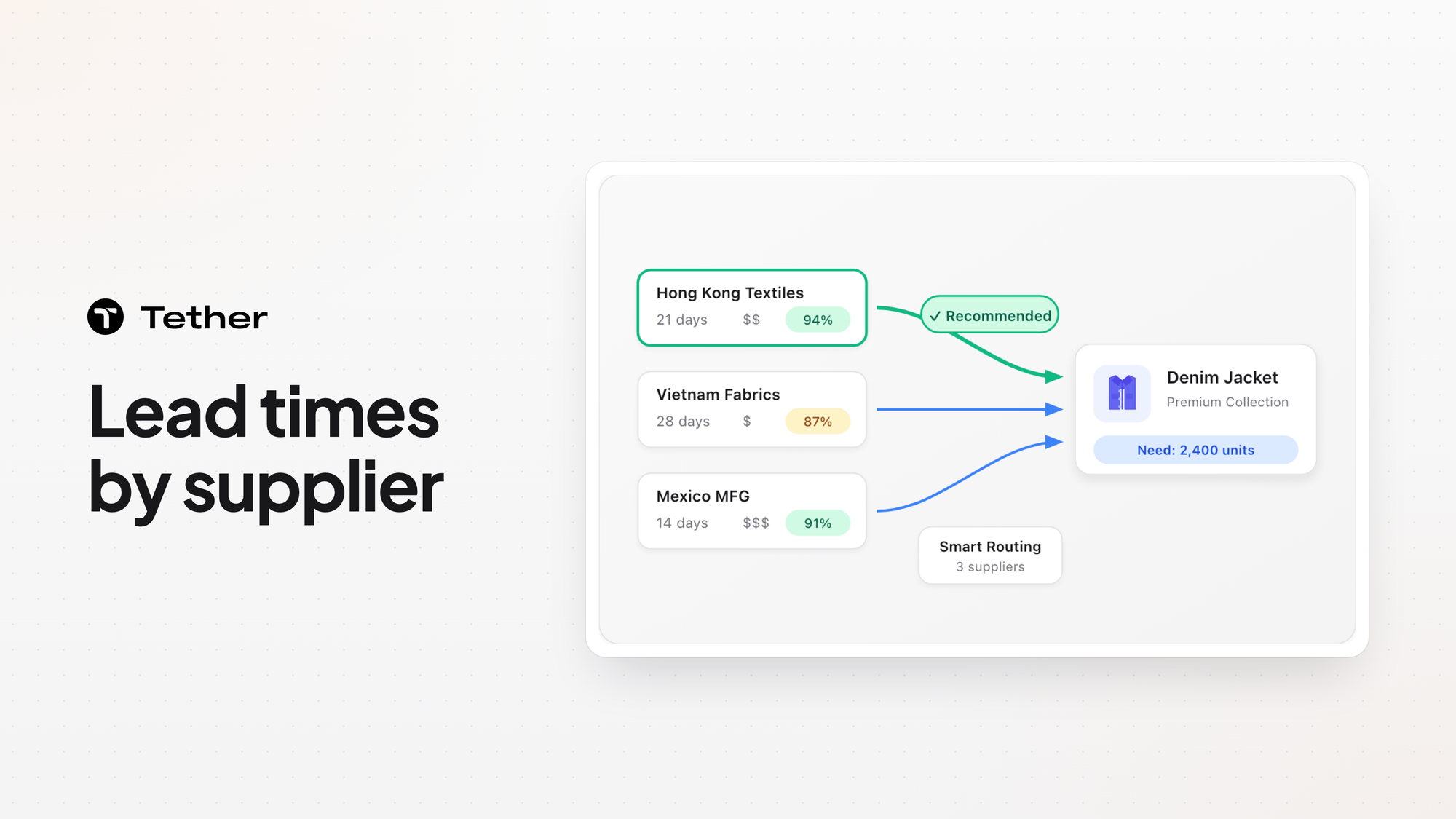
Tether keeps multiple suppliers per product, and you can draft each purchase order to your fastest, cheapest, or most reliable supplier. Tether's supply planning respects MOQs, lead times, batch sizes, and pallet counts. You can base every reorder on actual supplier deliveries and follow every order from draft to delivery.
Give each product more than one supplier
Tether keeps multiple suppliers per product without losing track of who delivers what. In supply planning, you can split orders across suppliers by your own rules.
Tether also tracks on-time delivery and quality so sourcing sharpens over time.
Lead times based on what suppliers actually deliver
Every reorder can rest on what suppliers have actually delivered instead of on guesswork. Tether tracks production and shipping time separately, so each estimate holds up. You can spot trends in past lead times and set expectations you can keep.
In supply planning, you can also plan around supplier holidays so a closure never catches you off guard.
Supplier minimums are built into every draft
Each draft already respects your supplier minimums, lead times, and preferences, so you skip the spreadsheet math. On the supply planning side you can also:
- Meet every MOQ without overstocking to get there.
- Respect batch sizes and the pallet counts your warehouse needs.
- Build in packaging rules so orders arrive ready for your warehouse.
Purchase orders drafted at your reorder point
In purchase order management, drafts appear the moment your coverage hits your reorder point. Coverage is the days of stock you have left.
The reorder point is a rule you set. In inventory management, you define reorder points so replenishment drafts trigger on time.
Tether drafts each order, and your team places it. In the Tether app, you can also ask Tether AI to draft POs in plain English.
Every order tracked from draft to receipt
Tether tracks every PO from draft to shipment to receipt. It syncs with your ERP and shows how incoming stock affects your forecast.
When an order falls outside your connected systems, you can enter it by hand in seconds. Your projections stay accurate even for offline or one-off orders.
FAQ
Can I see when a drafted order will land?
You can see whether an order actually prevents the stockout and exactly when it lands. Your coverage updates the moment an order is drafted, not when it arrives.
Can Tether plan raw-material and component orders too?
Tether can draft raw-material orders straight from finished-product demand. Tether AI plans component POs with lead times so materials land on time.
Does Tether work with my ERP and 3PLs?
Tether connects to the warehouses and 3PLs you already use, and your 3PL or WMS still runs the floor. You can run Tether as a planning layer on top of the ERP you already have, as a replacement for an ERP you have outgrown, or as the foundational system for a brand with no ERP yet.
Do I need to clean my supplier data before starting?
The Tether team handles the data migration and mapping for you, and no data cleaning is required. Implementation typically takes 2 to 4 weeks.


