

How do you plan purchase orders around supplier holidays and factory shutdowns?
 Gary Sahota
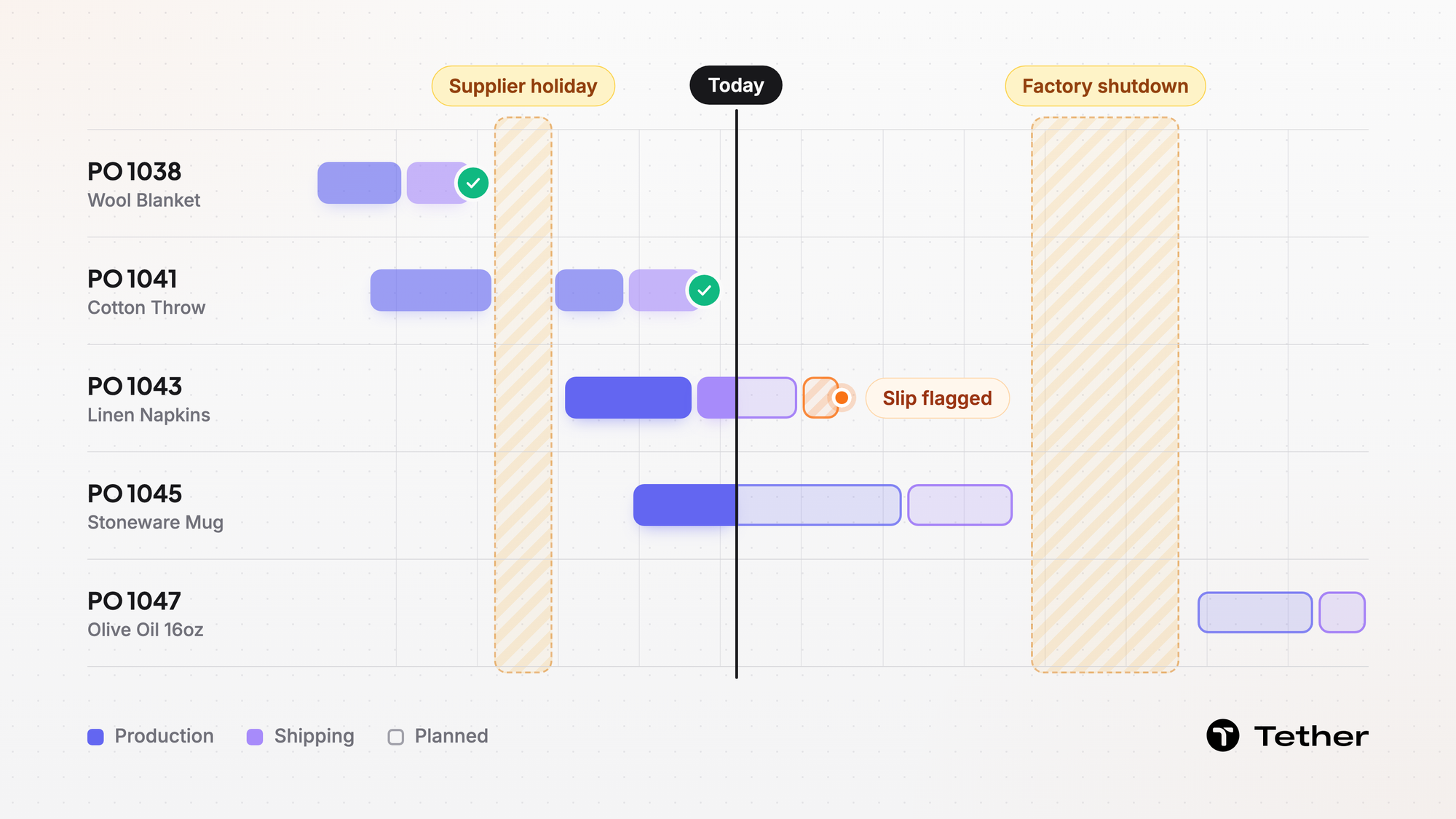
You plan purchase orders around supplier holidays and factory shutdowns by ordering ahead of each closure on lead times your suppliers actually hit. Tether lets you plan around supplier holidays so a closure never catches you off guard. Tether drafts purchase orders the moment your coverage hits your reorder point, and each draft already respects your supplier minimums and lead times.
Work back from the closure
A build-ahead order starts from the closure and works backward to the day you need to place it. These steps need no special tool, and they keep the order no bigger than the closure calls for.
- Confirm each supplier's closure dates and the last day it can finish and ship your order before it closes.
- Count back from that day by the supplier's production time to find the latest day your order has to be placed.
- Size the order to cover the demand you expect until your next order after the reopening lands. Subtract the stock you hold and the orders already open.
- Order no more than that. Extra stock ties up cash for the length of the closure.
Holidays can slow freight as well as factories, so check the shipping side of each order too.
Use lead times your suppliers actually hit
Every step above depends on the lead time, so it has to come from real deliveries. In supply planning, Tether lets you base every reorder on what suppliers have actually delivered, not guesswork.
Tether also tracks production and shipping time separately, so each estimate holds up. That split lines up with the steps above, where the production time sets your order date and the shipping time sets when the stock lands.
Raw materials need the same planning when a component supplier closes. In MRP, Tether works raw-material requirements back from finished-goods demand.
Size the order to your supplier's rules
An order placed ahead of a closure is larger than your usual cycle, and it still has to land on your supplier's terms. Tether's supply planning respects MOQs, lead times, batch sizes, and pallet counts.
In purchase order management, coverage is the days of stock you have left. The reorder point is a rule you set, and in inventory management you define reorder points so replenishment drafts trigger on time.
After you build ahead, Tether recommends reducing or cancelling a purchase, production run, or transfer you no longer need. That recommendation is a check on an order that turned out larger than you need.
Track the orders that span the closure
An order due to ship just before a closure is the one to watch, because a short slip can push it past the shutdown. Tether follows every order from draft to delivery.
For each of those orders, you get flagged the moment its delivery date slips. When a shipment slips, your forecast updates on its own.
After the factory reopens, Tether runs an automatic analysis and reconciliation of the initial plan against the actual receipt. You can spot trends in past lead times and set expectations you can keep. For the wider view of supplier terms and order tracking, read the supplier lead times and purchase order guide.
FAQ
Does Tether place the build-ahead order on its own?
Tether drafts and recommends, and your team decides what gets ordered. When Tether predicts a stockout, it recommends a purchase or transfer. Nothing is ordered until someone on your team accepts it and places the order.
Does Tether flag supplier problems automatically?
Coverage weighs demand and incoming POs together, so stockouts get flagged while you can still act. That works alongside the delivery-date slip alerts described above. Tether also tracks on-time delivery and quality so sourcing sharpens over time.
Can I order from another supplier while my main one is closed?
Tether keeps multiple suppliers per product without losing track of who delivers what. You can split orders across suppliers by your own rules. You can also draft each PO to your fastest, cheapest, or most reliable supplier.
Can Tether show which products a closure will leave short?
Tether predicts the stockout date for each SKU at each warehouse, which you can read against the closure dates you confirmed with the supplier. It shows days of stock rather than a raw number, and each product's health status recalculates automatically as demand fluctuates.
Can I see what Tether AI changed while we prepared for a closure?
In the Tether app, each change Tether AI makes is recorded in a visible edit log. Each entry shows who, what, why, before, and after. When you push orders to other systems, Tether keeps the full record.


