

Multi-layer bill of materials for SKU management
 Gary Sahota
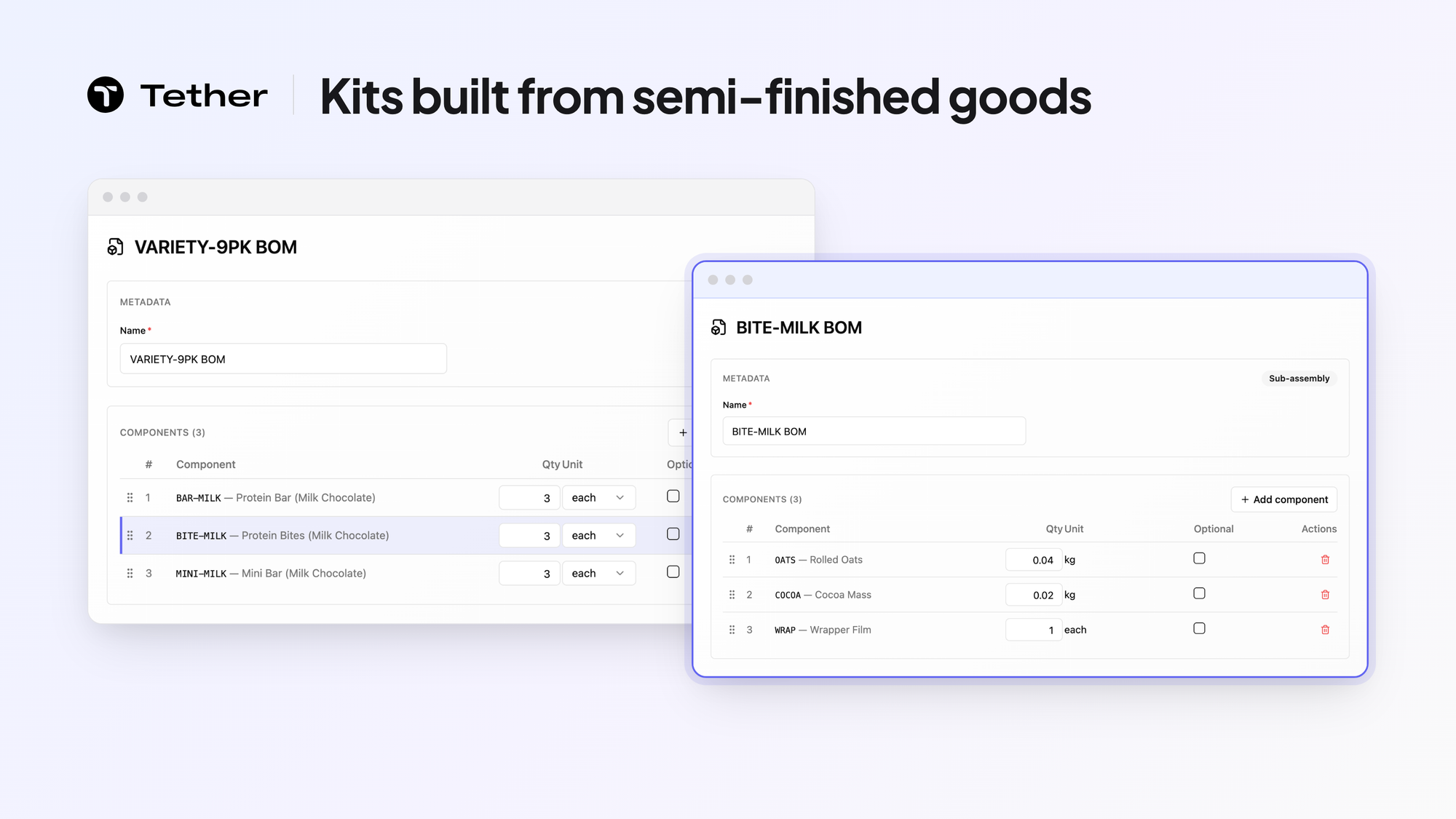
Tether supports multi-layer bills of materials (BOMs) that include semi-finished goods and kits, and new products inherit their BOM automatically. Every SKU in Tether has a type, such as finished good, component, kit, or virtual bundle. That matters for SKU management, because the BOM is the record of what goes into each SKU you make or assemble.
Why BOM management matters
A BOM tells your team what a SKU is made of, so purchasing and production plans for that SKU start from it. When a BOM is wrong or out of date, the mistake carries forward. The team orders too little of a material, a production run comes up short, or a product looks cheaper to make than it really is.
Each stage feeds the one above it, so a mistake low in the BOM carries upward. A missing wick in the BOM for a poured candle jar also leaves out the wick for every candle and gift set built from that jar.
When the BOM cannot hold those stages, your team tracks them somewhere else, and that place is often a spreadsheet. Our post on moving supply planning off spreadsheets covers why that gets harder as a brand grows.
Common types of BOMs and SKUs
The types most consumer brands mix in one catalog are recipes, finished goods, semi-finished goods, work in progress, kits, and bundles.
- A recipe is what many food, beverage, and beauty brands call a BOM. It lists ingredients and amounts rather than parts.
- A finished good is ready to sell as it is. A single candle is one example.
- A semi-finished good is something you make and hold before it becomes a product you sell. Wax poured into a glass jar and left to set is one example. It still needs a lid and a label.
- Work in progress is stock partway through a production run. It is no longer raw material but not yet ready to sell.
- A kit groups other items into one product. A candle gift set is a common example.
- A bundle sells several products together under one listing. Some brands pack a bundle only when an order comes in.
Each SKU in Tether has a type: finished good, component, variant, bundle, kit, or virtual bundle. The product management page lists support for complex SKUs such as virtual bundles and semi-finished goods. Each organization in Tether can use its own word for a BOM, such as Recipe. The next section shows how a semi-finished good and a kit each fit in as a BOM layer.
Semi-finished goods and kits are layers in a Tether BOM
Each stage of the candle example can be its own layer in a Tether BOM. The MRP page lists support for multi-layer BOMs. Written out from the top, the layers look like this:
- Candle Gift Set is the kit at the top. It holds several Lavender Candle units.
- Lavender Candle is the finished good. It combines a Poured Jar with a lid and a label.
- Poured Jar is the semi-finished good. Its raw materials are wax, a wick, fragrance oil, and a glass jar.
Finished goods can be components in another BOM, such as the BOM of a virtual bundle. Tether blocks circular BOM references, such as two products that each list the other as a component.
New products inherit their BOM automatically
A new product you add to Tether picks up its BOM through automatic inheritance. That matters most for a brand that adds new products often.
FAQ
Do we have to replace our ERP to use Tether?
Tether does not require you to replace your ERP. It can run as a planning layer over the ERP you have now, replace an ERP you have outgrown, or serve as the foundational system for a brand that has no ERP yet.
What is a multi-level BOM?
Multi-level is another common name for a multi-layer BOM. That kind of BOM lists the items that go into a product and then the items that go into each of those, down to raw materials.
Is a layered BOM the same thing as MRP?
A layered BOM and MRP do different jobs. The BOM describes how a product is built, one layer at a time. MRP is the planning method that reads those BOMs to work out which materials to buy and when to buy them.


