

What is MRP and does a consumer brand with co-packers need it?
 Gary Sahota
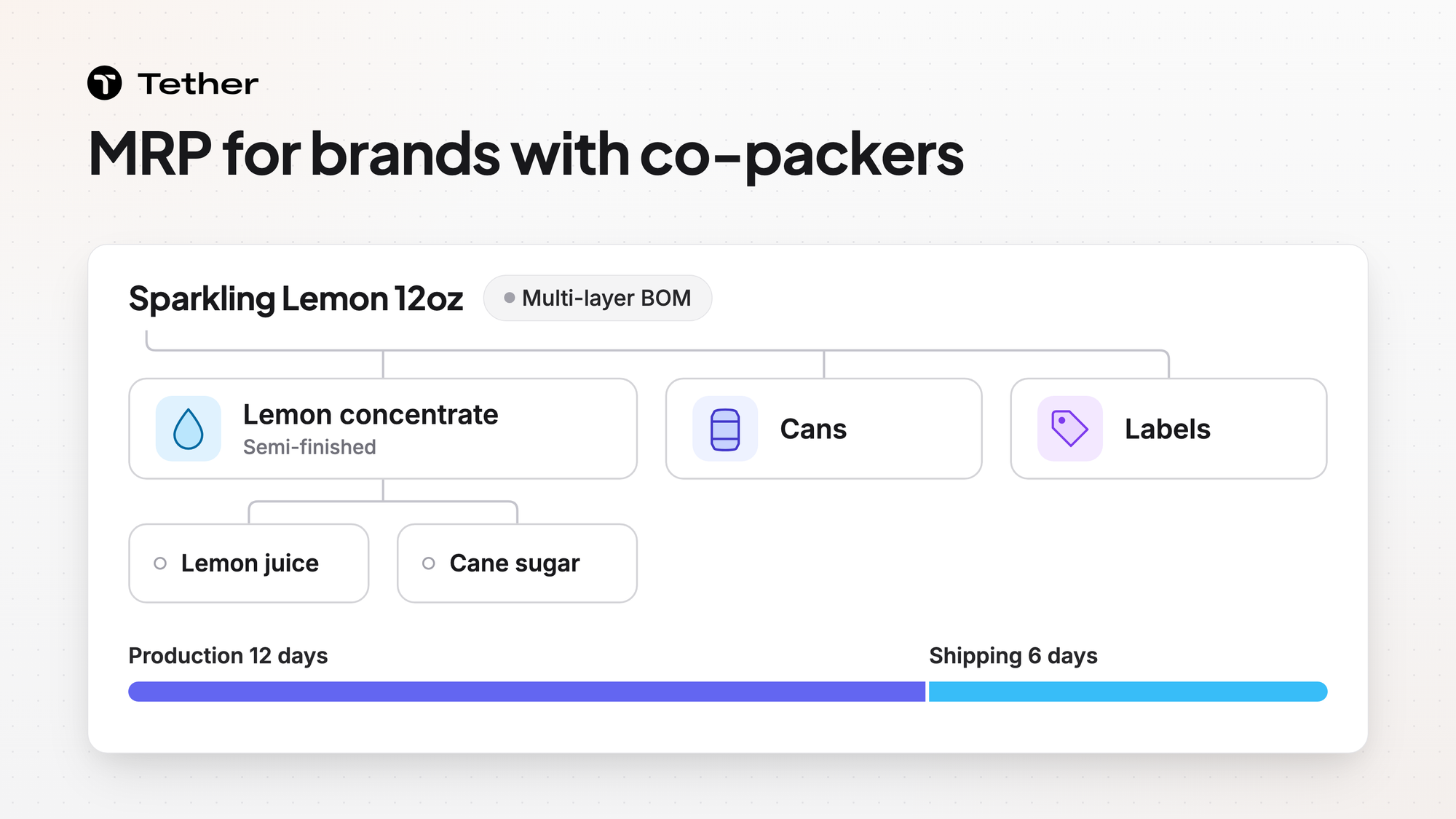
MRP (material requirements planning) uses each product's bill of materials to work out which raw materials, packaging, and components you need and when. A consumer brand with co-packers needs MRP when it buys some inputs itself and sends them to the co-packer. Tether handles multi-layer BOMs, keeps production time apart from shipping time, and can run on top of the ERP you already have.
What MRP works out
MRP starts from the finished goods you plan to make and works backward to every input they need. It draws on four sets of data:
- A production plan that says how many units of each finished product you will make and when
- A bill of materials (BOM) for each product that lists every input and the quantity in one unit
- The stock you already hold of each input and what is already on order
- How long each input takes to arrive once you order it
From those it calculates what you still need to buy or make, how much of it, and the date each order has to go out. Anything you already hold or have on order is netted off first so you only buy the gap. Every quantity MRP calculates comes from the BOM, which is why an error there shows up in every order.
A BOM can have more than one level. A variety pack is built from finished units. A finished unit can be built from a semi-finished good such as a filled bottle that has not been labeled yet. MRP walks down each level in turn so a shortage deep in the build still shows up against the product you sell.
Your co-packer agreement decides whether you need MRP
The answer depends on who buys the inputs that go into your product. Co-packing agreements can follow one of three patterns:
- In a turnkey agreement the co-packer buys every ingredient and packaging item and sells you finished goods. You plan finished goods and your partner runs its own material planning.
- In a brand-supplied agreement (also called toll manufacturing) you buy the inputs and ship them to the plant. You own the material plan for all of it.
- In a mixed agreement the manufacturer buys common inputs and you supply the rest. A brand might supply a proprietary ingredient and its printed packaging while the plant buys commodity inputs. Material planning is your job for the inputs you buy.
The brand-supplied and mixed cases are where brands get caught out. A run cannot start while one of your inputs is missing from the dock. A late label holds up the whole batch even when every other input is on site.
Signs a spreadsheet is no longer enough for materials
A spreadsheet works while you have a few products and each one has its own inputs. These signs point toward MRP:
- One input goes into many products. A bottle or carton shared across flavors or scents is the usual case.
- Your products are built in stages. A bulk batch is packed into several sizes or finished units are bundled into kits.
- You send inputs to more than one co-packer and need to know how much of each sits at each site.
- Printed packaging comes with a minimum order and the co-packer sets a minimum run size. When the two differ you have to plan around both.
- Packaging takes longer to arrive than ingredients do. The order dates for a single run are then spread across weeks.
- A run has already slipped because one input was short.
What these signs share is that a shortage of one input stops a finished product. A plan for finished goods alone will not show that shortage until it is too late to fix.
Multi-layer BOMs in Tether
A layer in a Tether BOM can be a semi-finished good or a kit. That covers a bulk product that is filled before it is packed and a variety pack built from other finished products. More detail is on the multi-layer BOM page.
A new product you add inherits its BOM automatically.
With a turnkey co-packer you plan finished goods
A turnkey co-packer turns material planning into a finished goods order. You still need to know how many finished units to order and when to order them.
Tether predicts the date each SKU will run out at each warehouse. A predicted stockout leads Tether to recommend a purchase or a transfer. Someone on your team has to accept that recommendation and place the order before anything is ordered.
In supply planning Tether keeps production time apart from shipping time so each lead time estimate holds up. Tether also tracks stock that is in production or in transit as states of its own next to stock on hand.
FAQ
Is MRP the same as an ERP?
MRP and an ERP do different jobs. MRP is a planning method and an ERP is the system that records orders, inventory, and accounts. Tether can sit as a planning layer on your current ERP, replace an ERP you have outgrown, or be the foundational system for a brand with no ERP yet.
How do you tell which co-packing model you have?
Look at who pays the supplier of each input. If you pay the ingredient or packaging supplier directly then that input is yours to plan. If the cost sits inside the co-packer's price per finished unit then the co-packer plans it.
How many levels should a BOM have?
Give the BOM a level for each stage where a product is stocked or handed off on its own. A bulk batch that is packed into several sizes is one level and each packed size is the next. In MRP a stage that is never stocked is called a phantom level and it passes its inputs straight through to the next level.
Do you need to clean up your data before moving it to Tether?
Tether does not require data cleaning before you start. Its team handles the migration and mapping of your data. Read more in the implementation FAQ.


