

How does Tether Data integrate with existing ERP systems without requiring a full replacement?
 Gary Sahota
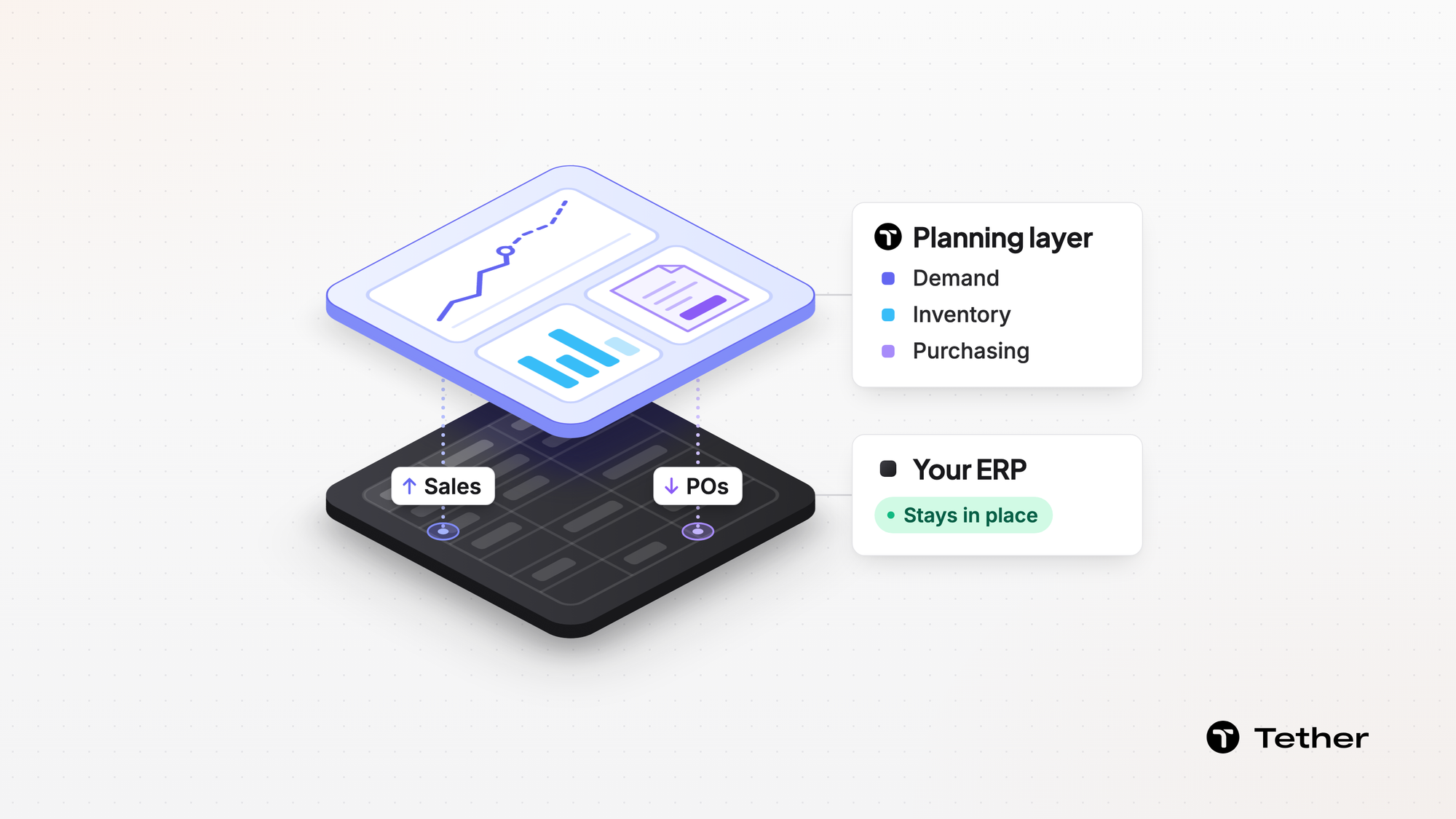
Tether can run as a planning layer on top of the ERP you already have. It pulls sales from your ERP and syncs purchase orders with it, and the Tether team handles the data migration and mapping. Delta syncs keep the sales numbers current in near real time.
Why brands keep their ERP and add a planning layer
Brands often keep their ERP because it already runs the parts of the business it was set up for, and the work that is missing is planning that ERPs do not traditionally focus on.
Your ERP may hold years of item, supplier, and accounting setup, and other systems may depend on its data. Replacing it means moving that history, rebuilding those connections, and retraining every team that uses it. Meanwhile, planners often fill the planning gap with spreadsheets that someone has to keep in step with the ERP.
Tether is modular. It can be a full ERP, or it can be built on top of the ERPs and WMSs you already run without replacing them.
The planning work Tether adds on top of your ERP
Tether adds demand, inventory, purchasing, supplier, and materials planning on top of your ERP.
- Demand: Planners can group and filter the demand forecast by channel or SKU. Tether AI runs many forecast models in parallel, including seasonal, momentum, SARIMA, and custom models. It also models new launches from look-alike SKUs with no history required.
- Inventory: Coverage is the days of stock you have left. It weighs demand and incoming POs together and flags a stockout while your team can still act. Tether recommends reorders and transfers for each SKU at each warehouse.
- Purchasing: PO drafts appear the moment your coverage hits your reorder point. Each draft already respects your supplier minimums, lead times, and preferences.
- Suppliers: Tether can split orders across suppliers by your own rules. It bases reorders on what suppliers have actually delivered. Your team can spot trends in past lead times.
- Materials: Tether works raw-material requirements back from finished-goods demand. It supports multi-layer BOMs for semi-finished goods and kits.
- Course corrections: Tether recommends reducing or cancelling a purchase, production run, or transfer you no longer need.
When Tether predicts a stockout, it recommends a purchase or transfer, and nothing is ordered until someone on your team accepts it and places the order.
How Tether layers on top of your ERP
Tether reads planning data from your ERP and your other systems, and it syncs purchase orders with your ERP.
On the way in, Tether can pull sales from your ERP or from Shopify, Amazon, EDI, and data warehouses like BigQuery and Snowflake. Your existing demand plans come in as well, along with sales history, inventory position, and purchase orders.
On the purchasing side, purchase order management tracks each PO from draft to receipt and shows how incoming stock affects your forecast. When a shipment slips, your forecast updates on its own. Tether flags you the moment a delivery date slips, long before it becomes a stockout. It also runs an automatic reconciliation of the initial plan against the actual receipt.
Your team can push orders to other systems while Tether keeps the full record.
How Tether AI makes the planning layer agentic
In the Tether app, Tether AI drafts POs and other changes, and the app records each change in a visible edit log. The log shows who, what, why, before, and after.
Tether AI replans on every change, such as a new warehouse, a new SKU, or a new cost. It tracks forecast variance in real time so you can course-correct early. It drafts Monday's POs over the weekend, so your team arrives to a queue.
With standing reports, Tether AI builds a custom report with tables and charts on request. It reruns that report on a schedule such as daily, weekly, or monthly.
FAQ
Can Tether replace our ERP instead of running on top of it?
Tether can run as a replacement for an ERP you have outgrown. That is one of three ways to run it, alongside a planning layer on top of the ERP you already have and the foundational system for a brand with no ERP yet.
Which ERPs and other systems does Tether work with?
Tether AI plays nicely with NetSuite, Acumatica, and Brightpearl. For NetSuite, Tether can send planned orders once your team has accepted them. The integrations page lists 245+ integrations. Tether AI also exposes a REST API for custom integrations.
Can Tether read orders that arrive as PDFs?
Tether AI reads PDF purchase orders and sales orders, then waits for a person to check them. Tether AI also ingests other formats, such as CSVs, Excel files, and screenshots, and needs no templates.
Do we need to clean our ERP data before we start?
No data cleaning is required. Tether AI maps your data as-is and surfaces a health dashboard for anything misconfigured. It also maps many external IDs to one internal SKU.
How long does implementation take?
Implementation typically takes 2 to 4 weeks. During onboarding, your team can join optional weekly 30-minute calls with Tether.
What support does our team get once Tether is running?
Every plan includes a dedicated Slack channel or email for support. Tether responds to urgent requests within 24 hours and guarantees 99.5% uptime.
Does Tether replace our WMS or 3PL?
Your 3PL or WMS still runs the floor. A 3PL or WMS connection brings sales orders, inventory levels, and purchase orders into Tether, and Tether unifies your own warehouses and 3PLs into one stock view. It decides where each order goes under routing rules you build. Integrating 3PLs and warehouse management systems with Tether covers that side in more detail.


