

What is the difference between demand planning and supply planning?
 Gary Sahota
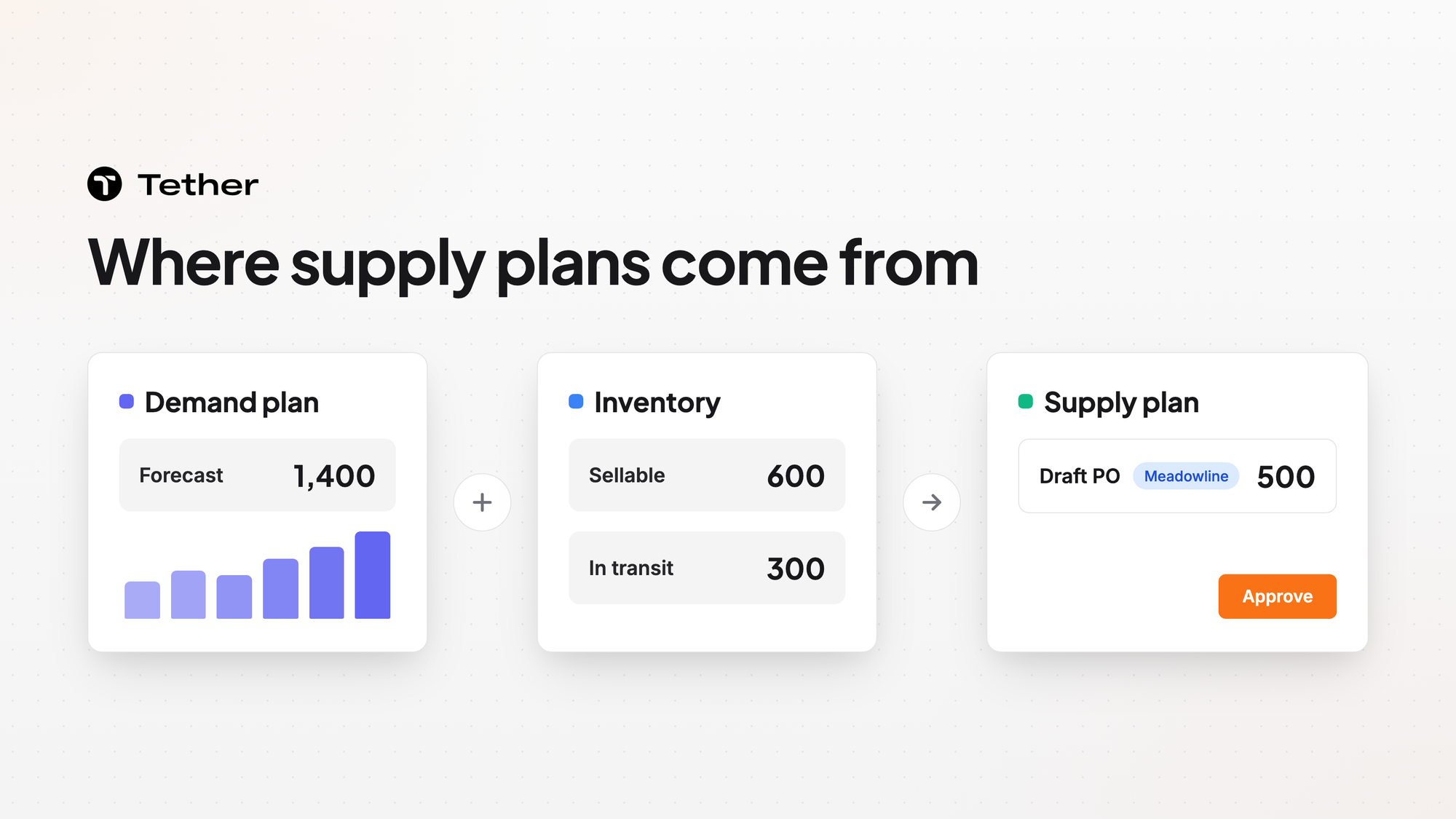
Demand planning in Tether pulls your sales data to estimate what customers will buy and when. Supply planning in Tether drafts purchase orders that respect supplier minimums and lead times. Inventory management is the third piece. Any supply plan starts from the forecast plus the stock on hand and on order. In the app, Tether recommends a purchase and your team places the order.
Demand planning estimates what customers will buy
Demand planning turns sales history into a forecast of units for each SKU and channel over the coming weeks and months. A demand planner starts with what sold. The planner then adjusts that baseline for what will be different next time:
- Promotions and price changes
- Product launches with little or no sales history
- New retail accounts and marketplaces
- Seasons and holidays
A brand that sells through its own store, Amazon, and wholesale has demand spread across several systems. Before anyone can forecast well, those channels have to land in one place at the SKU level. Demand planners then judge their work by forecast accuracy and by forecast bias, which is whether the forecast runs high or low over time.
In demand planning Tether pulls sales from Shopify, Amazon, EDI, ERP, or data warehouses like Google BigQuery and Snowflake. Numbers update near real-time with lightweight delta syncs.
Inventory management tells you what you already have
Inventory management keeps the record of what stock you hold, where it sits, and what state it is in. Inventory tells you how much of the forecast you can already cover with stock you hold.
Any comparison of demand planning and supply planning has to include inventory. A supply plan built from the forecast alone orders too much because it ignores stock already on the shelf and stock already on its way. A large on-hand count can also hide a shortage when much of it is promised to open orders or cannot be sold. Before a planner decides what to buy, they need four answers:
- How many units can be sold today
- How many are already committed to orders
- How many are in production or in transit
- Which warehouse each of those units sits in
Tether tracks stock by state: on hand, sellable, committed to orders, unsellable, in production, and in transit. In inventory management Tether predicts the stockout date per SKU per warehouse.
Supply planning turns the forecast and your stock into orders
Supply planning works out what to buy or make so stock is in place when demand arrives. In its simplest form the math reads like this. Take the demand you expect over a supplier's lead time and add the safety stock you want to keep. Subtract the stock you can sell today and the stock already on order. What is left is what you need to order. Planners call that number the net requirement. For finished goods bought from suppliers this work is often called replenishment planning.
Real suppliers then reshape that number with constraints the forecast never sees:
- How long each supplier takes to produce and ship
- The minimum quantity a supplier will accept and the batch or pallet sizes it ships in
- Closures and holidays that pause a supplier
- Which supplier to use when more than one makes the same product
Supply planners judge their work by stockouts, excess stock, and how often orders arrive on time.
In supply planning Tether respects MOQs, lead times, batch sizes, and pallet counts. It tracks production and shipping time separately so each estimate holds up. You can draft each PO to your fastest, cheapest, or most reliable supplier. You can also plan around supplier holidays so a closure never catches you off guard. In Tether you can base every reorder on what suppliers have actually delivered and spot trends in past lead times.
Purchase order drafts in Tether appear the moment the days of stock you have left hit your reorder point. Our guide to supplier lead times and purchase orders covers those supplier rules in more depth.
Each plan has to react when another one changes
The three plans work only when a change in one reaches the other two. Together they form the core of supply chain planning. When a promotion raises the forecast, the supply plan needs more units sooner. When a supplier ships late, the stock you counted on is not there in time. When the plans drift apart you get a stockout on one SKU and excess stock on another.
Many brands reconcile the plans once a month in sales and operations planning (S&OP). Demand, supply, and finance review one set of numbers and agree on what to buy, make, and hold.
In Tether you get flagged the moment a delivery date slips, long before it becomes a stockout. When Tether predicts a stockout it recommends a purchase or transfer.
Industry decides which constraints carry the most risk
Every consumer brand runs the same three plans. Where the work gets hard depends on what you sell.
- Apparel brands forecast by style, color, and size. Much of a season's order goes to the factory months ahead and is hard to change later.
- Food and beverage brands plan around shelf life. Ingredients and packaging have to arrive in time for each production run at the co-packer.
- Supplement and wellness brands often sell on subscription. Subscriptions make demand steadier. Co-manufacturer lead times decide how early the next run has to be booked.
- Home goods and furniture brands live with long lead times and bulky stock. Each order ties up cash for months before it sells.
- Toy and collectible brands earn a large share of the year in the holiday season. Stock has to be in place before demand peaks because there is little time to reorder once it starts.
- Beauty brands launch new shades and sizes that pull sales from existing ones. Bottles, pumps, and other components often have their own lead times.
In each category the supply plan still starts from the forecast and the stock you hold. The category decides which constraints shape the order and how far ahead you have to commit.
FAQ
What is the difference between demand forecasting and demand planning?
Forecasting is the statistical estimate of what will sell. Demand planning is the process around that estimate. Sales, marketing, and operations review it and agree on the number the business will plan against.
What is the difference between inventory planning and inventory management?
Inventory planning sets the targets you want to hold, like safety stock, reorder points, and days of cover. Inventory management tracks the stock you actually have against those targets day to day. Both feed the supply plan.
Where does MRP fit?
MRP is supply planning for the raw materials and components that go into what you make. It matters most for brands that buy their own inputs and send them to a factory or co-packer. Tether supports multi-layer BOMs for semi-finished goods and kits. New products inherit their BOM automatically.
Who owns the forecast and who owns the orders?
Demand planners usually own the forecast. Supply planners or buyers own the orders that follow from it, and on a small team one person often does both jobs. In the Tether app every order arrives drafted and your team places it.
Where does Tether AI fit in?
Tether AI drafts POs and other changes in the Tether app. Each change is recorded in a visible edit log that shows who, what, why, before, and after.
Can Tether run demand planning and supply planning alongside your ERP?
Tether can run as a planning layer on top of the ERP you already have, as a replacement for an ERP you have outgrown, or as the foundational system for a brand with no ERP yet. Purchase order management in Tether syncs with your ERP. In order management Tether connects to the warehouses and 3PLs you already use and decides where each customer order should go under routing rules you build. Your 3PL or WMS still runs the floor.


